Google’s launch of Gemini 3.5 Flash has ignited excitement among developers and workflow architects. However, upgrading to a newly released model can bring unexpected operational friction.
If you are already running an AI-driven service, you might be wondering: “Is migrating to 3.5 Flash going to spike my API bills?” or “If I stick with the cheapest 3.1 Flash-Lite to save money, will my complex multi-stage agentic workflow start crashing due to poor performance?”
Relying blindly on benchmark marketing can lead to severe sticker shock. Conversely, choosing the absolute cheapest option for a complex multi-step pipeline might result in database errors and countless hours spent restoring lost data.
To help you balance budget and intelligence, we’ve put together a practical, real-world comparison of Google’s core Gemini lineup: 3.0 Flash, 3.1 Flash-Lite, 3.1 Pro, and the newly released 3.5 Flash. Reading this guide will help you design a smart model-routing strategy that can shave at least 30% off your monthly API expenditures.
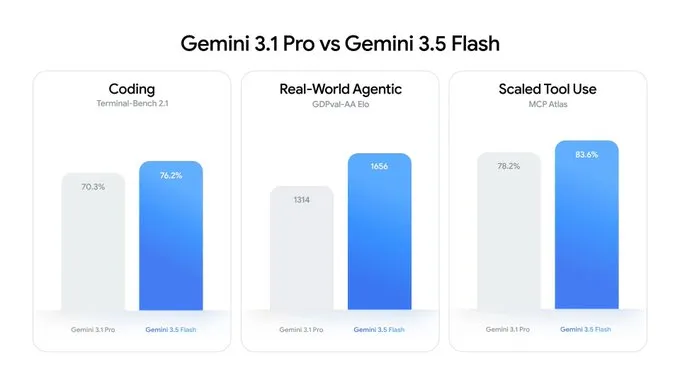
- The Core Shift: Gemini 3.5 Flash is not just a standard budget model. It has been re-engineered as a specialized, high-performance engine that beats the premium 3.1 Pro in agentic tasks and coding.
- Strategic Routing: Keep your basic text classification or translation routed to the ultra-cheap 3.1 Flash-Lite, but swap your heavy agentic loops and debuggers from 3.1 Pro to 3.5 Flash.
- Expected Outcomes: Proper, granular model routing allows you to reduce your infrastructure API bills by 30% or more without sacrificing quality.
1. The Budget Dilemma: “Wait, a 6x Price Spike?”#
If you aren’t familiar with the initial release of Gemini 3.5 Flash, its technical architecture, or how to get a free API key, check out our companion piece: Google Gemini 3.5 Flash Released: The Ultimate Agentic-First LLM for Speed and Workflow Automation first.
If you have been relying on Gemini 3.0 Flash or 3.1 Flash-Lite to power massive batch operations, the 3.5 Flash pricing page might shock you. Despite carrying the “Flash” moniker, its pricing is far from lightweight.
Let’s look at the numbers:
| Model Name | Input Cost (per 1M tokens) | Output Cost (per 1M tokens) | Value-for-Money Grade |
|---|---|---|---|
| Gemini 3.1 Flash-Lite | $0.25 | $1.50 | Extreme Value (100/100) |
| Gemini 3.0 Flash | $0.50 | $3.00 | Decent Budget (60/100) |
| Gemini 3.5 Flash | $1.50 | $9.00 | 6x more expensive than 3.1 Flash-Lite |
Compared directly to 3.1 Flash-Lite, Gemini 3.5 Flash is exactly 6 times more expensive for both input and output.
Over in developer communities, this price jump was met with immediate pushback. As one architect on HackerNews pointed out: “A 6x price jump for the next iteration of the same model tier is practically unheard of in recent IT history. We desperately need another round of extreme price optimization like what DeepSeek did.”
Users on Reddit’s Antigravity forums echoed similar frustrations: “It feels like Google is pulling a classic bait-and-switch—getting everyone hooked on dirt-cheap Flash APIs and then raising the floor.”
The lesson here is simple: Do not mindlessly migrate raw, high-volume, low-complexity tasks (like simple translation or massive text scrubbing) from Flash-Lite to 3.5 Flash.
2. The Premium Opportunity: “Can it truly replace 3.1 Pro?”#
However, if you look at the premium end of your infrastructure, the picture changes entirely. If you have been relying on Gemini 3.1 Pro to run advanced autonomous agents, 3.5 Flash represents a massive cost-saving opportunity. It delivers “Pro-grade intelligence 25% cheaper and 4x faster.”
According to Google DeepMind’s official model card and social analyses, 3.5 Flash directly challenges the heavier 3.1 Pro in several critical categories:
| Benchmark / Evaluation | Gemini 3.5 Flash | Gemini 3.1 Pro | Verdict |
|---|---|---|---|
| Agentic Control (MCP Atlas) | 83.6% | 78.2% | ⚡ 3.5 Flash Dominates |
| Terminal Coding (Terminal-Bench 2.1) | 76.2% | 70.3% | ⚡ 3.5 Flash Wins |
| Visual Chart Reasoning (MMMU-Pro) | 83.6% | 80.5% | ⚡ 3.5 Flash Wins |
| Abstract Reasoning (ARC-AGI-2) | 72.1% | 77.1% | 🛡️ 3.1 Pro Wins |
| Expert-Level Exam (Humanity’s Last Exam) | 40.2% | 44.4% | 🛡️ 3.1 Pro Wins |
| Long-Context 128k+ Retrieval (MRCR v2) | 77.3% | 84.9% | 🛡️ 3.1 Pro Wins (Flash Degrades) |
Google DeepMind CEO Demis Hassabis publicly praised the model: “Gemini 3.5 Flash is fantastic! It directly surpasses 3.1 Pro on several of our core capability benchmarks.”
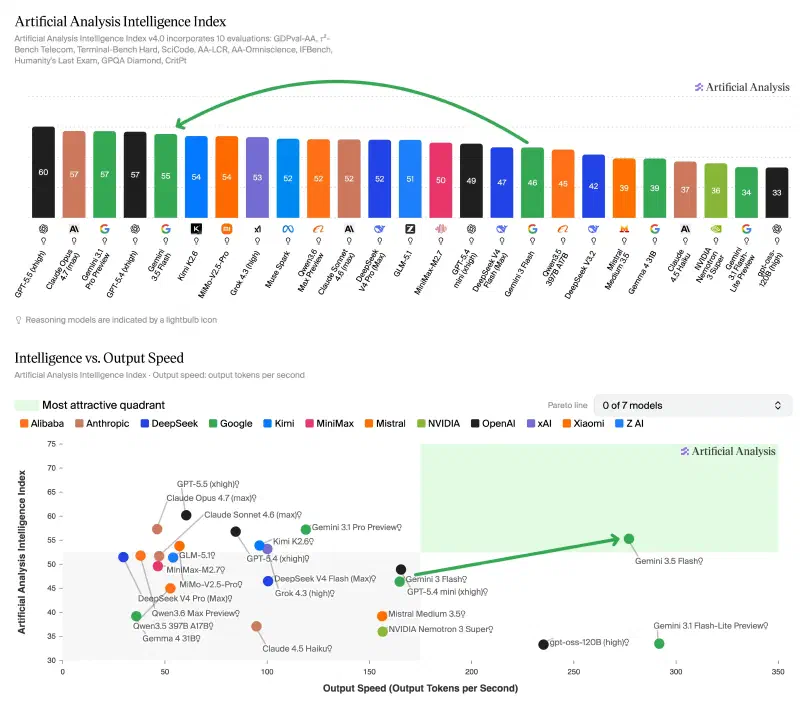
Independent analysis firm Artificial Analysis also confirmed its performance, labeling 3.5 Flash a “clear leader” in balancing processing speed and qualitative output.
Clocking in at 289 tokens/sec, 3.5 Flash is roughly 4 times faster than 3.1 Pro. For latency-sensitive apps like customer chatbots or real-time terminal coders, this makes a massive difference in user experience.
However, as the benchmark table demonstrates, 3.5 Flash is not a silver bullet. It has clear limitations in pure abstract reasoning, highly specialized academic logic, and long-context precision above 128k tokens.
Therefore, 3.5 Flash should be treated as a highly agile, specialized agentic engine, not a generic replacement for the broad, heavy reasoning capabilities of a Pro model.
3. The Model-Routing Guide: Match Your Tasks Smartly#
To keep this simple, here is a practical routing map to protect both your budget and your user experience:
📌 Routing 1: High-Volume, Low-Complexity ➔ Choose Gemini 3.1 Flash-Lite#
- Use Cases: E-commerce customer review sentiment classifiers, basic multi-language live chat translators, or voice memo transcript scrubbers.
- Why: The intelligence requirements are low, but the transaction volume is high. At $0.25 per million tokens, you can run massive pipelines for weeks without breaking the bank.
📌 Routing 2: Interactive Agents, Visual Analysis, & Coding ➔ Choose Gemini 3.5 Flash#
- Use Cases: Multi-agent software engineering pipelines, visual data extraction (parsing complex flowcharts/graphs), or autonomous calendar-booking agents.
- Why: It beats the older 3.1 Pro in speed and agentic control, while costing 25% less than the Pro model’s standard rates (Input: $1.25, Output: $10.00).
📌 Routing 3: High-Logic Academic Reasoning & Heavy RAG ➔ Choose Gemini 3.1 Pro#
- Use Cases: Legal contract audits requiring rigorous clause validation, advanced medical diagnostic support, or deep RAG pipelines parsing 100k+ tokens of dense corporate reports.
- Why: 3.1 Pro remains superior at deep information retrieval across extremely long documents. Gemini 3.5 Flash’s accuracy drops noticeably when context starts stacking past the 128k token mark.
4. Two Practical SDK Tweaks to Lower 3.5 Flash Costs#
If you decide to deploy 3.5 Flash in your production pipelines, make sure your engineering team implements these two cost-saving configurations:
Tweak 1: Control thinking_level to Limit Overhead#
Gemini 3.5 Flash uses an internal “Thinking” loop to plan its logic before spitting out text. By default, this is set to medium. For simpler tasks that do not require deep logical parsing, you can dial this down to low or minimal to prevent paying for unnecessary “thinking tokens.”
# Utilizing the latest google-genai SDK to limit thinking overhead
from google import genai
from google.genai import types

client = genai.Client()

response = client.models.generate_content(
    model="gemini-3.5-flash",
    contents="Draft a summary of our regional sales report data.",
    config=types.GenerateContentConfig(
        # Limit the thinking effort to keep latency and costs at a minimum
        thinking_config=types.ThinkingConfig(thinking_level="low")
    ),
)
print(response.text)
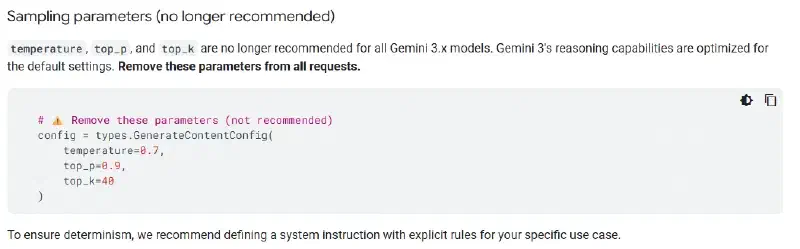
Tweak 2: Drop the Obsolete temperature and top_p Parameters#
Many developers have a habit of passing parameters like temperature=0.7 or top_p=0.9 as a default legacy config.
However, according to the official documentation, Google AI for Developers - What’s New in Gemini 3.5, the 3.x reasoning engine is fully optimized around default sampling parameters.
Overriding these values can interfere with the model’s internal reasoning loops, degrading performance or throwing blank API returns. When utilizing 3.5 Flash, completely strip these legacy parameters out of your client calls.
5. Designing the Optimal Infrastructure#
Optimizing an AI-driven service isn’t about finding the single “best” model. It is about setting up a smart, automated traffic director.
By routing high-volume routine classification to 3.1 Flash-Lite, deploying 3.5 Flash to power your active agents, and reserving 3.1 Pro for heavy logical validation, you can cut your monthly cloud API bill by 30% while actually improving the response speed of your application.
If you have questions about routing configurations or are hitting error codes with the new SDK, drop a comment below!
6. Frequently Asked Questions#
What is the most common error when migrating legacy code to 3.5 Flash?
The most frequent issue is API errors or blank returns (finish_reason: STOP) caused by legacy temperature, top_p, or top_k parameters in your code. Strip these out entirely; the 3.5 reasoning engine requires default values to operate correctly.
I am building a creative chatbot, but 3.5 Flash keeps throwing safety blockages. Why?
Communities like Reddit’s r/SillyTavernAI have noted that 3.5 Flash shipped with exceptionally aggressive safety filtering out-of-the-box. For creative writing or roleplay scenarios, you will likely need to stick with 3.1 Pro or craft incredibly precise system instructions to bypass overly sensitive safety triggers.
3.5 Flash has a knowledge cutoff of January 2025. How do I fetch real-time data?
If your application relies on real-time world events, you should enable Google Search Grounding within your API call configurations. This allows the model to query active search results and bypasses the static January 2025 cutoff.